
Conbinis, two ways
What Japan and Taiwan each did with the same convenience store — and what it says about both of them

This week, the Conbini Boys are excited to welcome Yanyu 煙雨 of yanyuletters. The Yanyu Newsletter covers East Asian diaspora culture — the aesthetics, the economics, the food, and the things that travel and the things that don’t. Be sure to subscribe!
We take turns exploring Taiwanese and Japanese convenience stores.
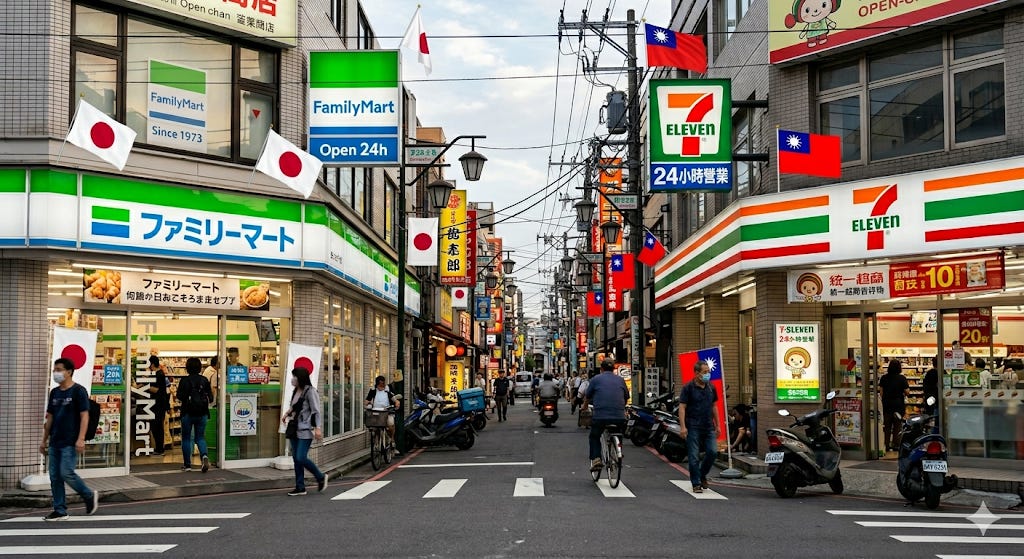
7-Eleven and FamilyMart exist in Japan and Taiwan, and in both countries it has become something the American original never quite managed to be: a genuine institution. Not just a place to grab something on the way somewhere else, but a place that is itself the destination. The same brand name, the same color scheme, the same basic premise — and two very different expressions of what a convenience store can mean when a culture takes it seriously.
What follows is a category-by-category comparison: one star from Japan, one from Taiwan, across five rounds. No winners. Just two countries doing the same thing differently, both extremely well.
01 — Hot Food
Taiwan
The hot food counter in a Taiwanese 7-Eleven operates on the same logic as a night market stall — grab and go, but with the full satisfaction of something kept at the right temperature all day. The star is the oden section: a deep container of broth holding fishcakes, tofu, radish, and the item that defines the whole experience, the tea egg. The tea egg has been simmering in soy sauce and spiced broth long enough that the shell has cracked into a marbled pattern and the egg itself has absorbed everything. It costs almost nothing. You eat it standing up, next to the counter, and you do not regret this.
Japan
The conbini hot box is a munchies paradise. Like devout Muslims on Hajj, at least once in their lives all snack-lovers should pilgrimage to Tokyo to pay homage to the conbini glass shrines sitting by the register encasing fried delights and steamed buns.
The primary hot box houses the conbini’s treasure: boneless fried chicken. At Lawson it’s L-Chiki, at FamilyMart Famichiki, and at 7-11 Nana-chiki. The competition over boneless fried chicken is so fierce that our podcast ran weekly for four years and only three times did we not discuss a new boneless fried chicken product in a segment called Chiki Wars.
It’s easily overlooked. After all, who travels to Japan to eat boneless fried chicken? You’re there for sushi, ramen, and kaiseki! Who in their right mind would spend precious yen on a hunk of chicken—from a convenience store no less!
But that first bite is a red pill moment. Like Neo in The Matrix, once you take a bite of that juicy flesh you give yourself to another culinary dimension. Whole new realms open up and you begin to question big things, such as, “Why did I spend $300 at Sushi Yasuda to choke down cod semen and egg cake when I could have been pounding tall boys and chiki for $5?”
Then you enter the second box: steamed Chinese buns. It’s a sauna. Enough condensation pours off the walls and ceiling to power a mini generator. Get past it. Reach deep inside your guts to find the strength to order “One nikuman, please” and you’ll never be the same.
The first bite is hot—too hot. Your tongue hurls the hot bun and seasoned meat desperate to cool it off. Once the pain settles the fireworks launch.
“Dear god.”
First, boneless fried chicken and now THIS?
The soft, supple bun. The subtly-sweet, umami-rich pork. It’s impossible to have just one, so you saddle back up to the counter rippling with the confidence of someone who has not just seen the light but is the source of it.
“One pizza-man, please.”
HOLY HELL! No. No. Please, not this.
Your world is collapsing. It can’t be! The Japanese have manifested a better version of pizza?! The tidy, steaming pouch stuffed with tomato sauce and melted cheese is the final straw.
You buy a tiny house deep in Shikoku’s forested mountains. During the day, you convene with Zen Buddhist monks seeking answers to impossible questions. During the night, you gorge on hot snacks that, in the end, provide all the answers you’ll ever need.
02 — Sando
Taiwan
The Taiwanese conbini sando tells you something specific about local taste. The combination that stays with me is strawberry jam with cream cheese — sweet and lightly salty, mild, not trying to be anything more than it is. This is the opposite of the maximalist sandwich. The bread is soft, the filling is gentle, the whole thing is designed for someone who wants something pleasant rather than something impressive. It reflects a broader Taiwanese palate that does not fetishize richness — the same sensibility that produces braised pork rice and scallion pancakes and century egg congee, foods that are deeply satisfying without ever being heavy. The sando is light on purpose.
Japan
Thanks to Anthony Bourdain the Conbini sando has reached Linsanity-levels of hype. Honestly, I don’t get it. Crustless white triangles smeared with egg salad or painted with a slice of ham and a lot of lettuce don’t get me excited. It may be because the British do a much better version of this at M&S, where for 5 pounds you can get a “Meal Deal”. This is a spectacular invention granting customers a sandwich—with crust on brown bread!—a bag of crisps or dessert and a beverage for a fiver. Once you’ve tasted the cheddar and pickle, it just gets hard to enjoy a lousy ham sandwich from FamilyMart.
Leave the sandwich behind! Aim for the hot box or grab a couple onigiri.
03 — Beverage
Taiwan
Taiwan invented bubble tea and takes its cold beverages seriously at every price point, and the conbini fridge reflects this. The standout is the shelf of bottled teas — oolong, green, barley, winter melon — that sit alongside the international brands without apology. These are not novelty drinks. They are what people actually drink every day, bought without ceremony, consumed on the MRT, finished before anyone notices. The tea culture that sustains an entire industry of independent tea shops also sustains the conbini cold case, and the quality differential between the two is smaller than you would expect. The convenience store tea is genuinely good. That is not nothing.
Japan
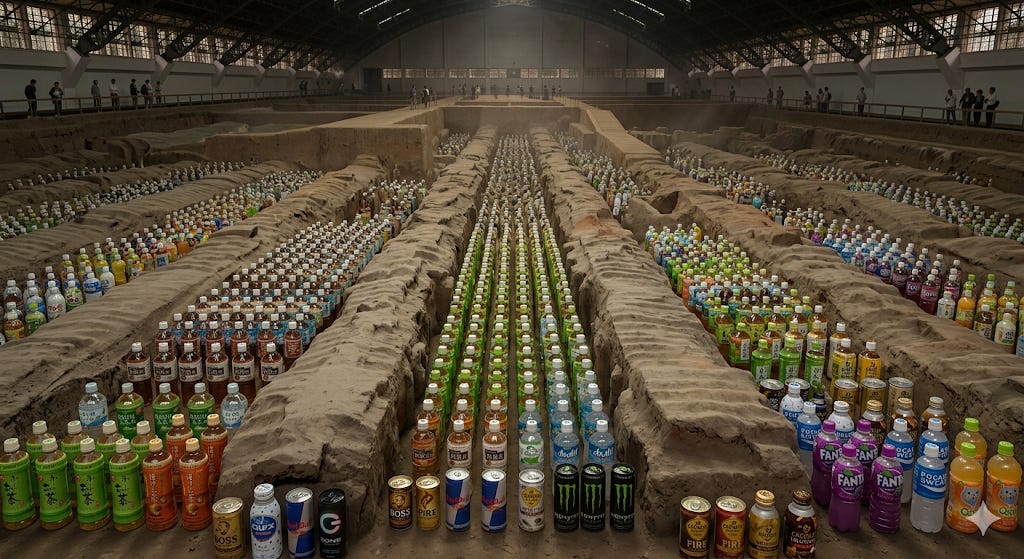
The conbini stacks beverages like the first Qin emperor stacks terracotta soldiers. Canned coffee, soda, sports drinks, black tea, green tea, roasted green tea, jasmine tea, water—and this fills just the fridge cases.
Feeling a little tired? Grab one of the little glass bottles called eiyou-dorinku or nutritional drinks at the endcap by the register. It’s pretty much Super Meth. Mexican cartels and Chinese chemical processors could only dream of concocting something so potent. I had one once feeling sleepy on a long drive. I didn’t blink for forty hours. Had the Biden campaign listened to me, America could have avoided a second Trump term.
The fresh beverages are a whole scene. Black coffee, lattes, cappacino, iced matcha lattes, mega iced earl gray tea, and melon frappés! At least thirty fresh beverages served by robot-baristas (aka “machines”) for 160 to 400 yen.
If it’s August and Japan’s humidity is dragging you down like a battleship anchor, grab a Pocari Sweat. If it’s winter, get a hot coffee. If you’re not sure what to buy, get a Boss bitou (slightly sweet and milky) canned coffee.
04 — The Thing That Isn’t Food
Taiwan
The Taiwanese 7-Eleven functions as a business center in a way that has no real equivalent anywhere else. Within a single visit, you can print documents from a USB drive, top up your EasyCard for the MRT, ship a package with a printed label, pay utility bills, buy concert tickets, and call a taxi. This is not a list of edge-case features — these are things that Taiwanese people actually do, regularly, on the way to work or on the way home. The store has absorbed the civic infrastructure of daily life in a way that makes it genuinely indispensable. It is not competing with Amazon or Uber or the post office. It has become the ambient layer underneath all of those things, the place where the physical and administrative world still connects.
Japan
The conbini is pretty much MacGyver. Remember the guy on TV who could assemble a thermonuclear weapon from a paperclip and some chewing gum? The conbini can do it, too. If you need something fast, the conbini has it.
Short on cash? Hit the ATM.
Tired of hauling luggage on the shinkansen? Forward it SAME DAY to your hotel.
Need to pay a heating bill? Pull up to the register.
Want to go to a concert? Grab some tickets.
Been looking for a trash can in all of Tokyo for the last twelve hours? The conbini’s got you covered.
05 — Wildcard: The Thing The Other Country Doesn’t Have
Taiwan
Themed stores. Taiwan has 主題門市 — conbini locations built around a specific character or aesthetic: Hello Kitty, Snoopy, LINE Friends, seasonal collaborations. The store itself becomes the thing. The shelving, the staff uniforms, the packaging, the exterior signage — all of it remade in service of the theme. This is not a pop-up or a limited window display. These are permanent stores that people seek out and photograph and return to. It reflects something true about Taiwanese consumer culture, which has always been comfortable with cute as a serious aesthetic category rather than a children’s one. The themed 7-Eleven is not ironic. It is not for kids. It is for everyone, and the line outside on a Saturday morning makes the case.
Japan
The unsung hero in Japan’s conbini is the toilet. It’s always pristine. The cleaning logbook hanging on the wall keeps better records than Korean dynasties. It’s so sparkling clean in there you could be tempted to unwrap an onigiri while you’re parked on the toilet.
Then you discover the bidet. Oh! Oh my! That’s….nice.
Toy with all the buttons. Get a feel for it. Splash a bit here and then there. Settle in.
Two countries, one store, five very different conversations. The same brand name became a tea egg counter in one place and a boneless fried chicken haven in another.
Now head over and subscribe to Yanyu 煙雨 .
Item of the Week
It’s tsuyu, the rainy season. The air is hot and wet. A Syrian prison run by Bashar al-Assad is more comfortable than the streets of Tokyo.
Japanese summer heat is indescribable. It’s a slimy monster that engulfs your body in a sticky blanket, smothering you in damp heat. Just a few minutes outside is enough exposure to soak your clothes in sweat.
The conbini offers two sorts of relief: air conditioning and icy treats.
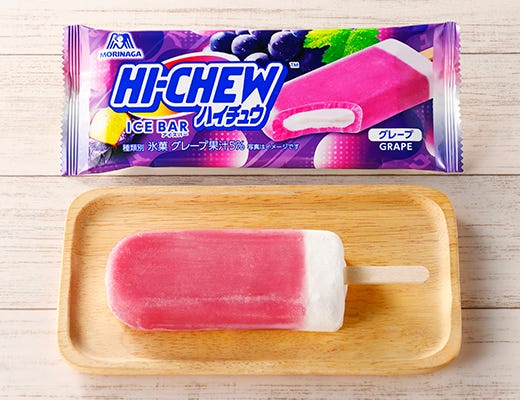
Lawson has a Hi-Chew ice lolly out. One will not be enough. Buy these by the case. Or better yet, the pallet. When salty ooze is pouring off of you, you’ll need as many frozen licks as you can find.
From the Dumpster
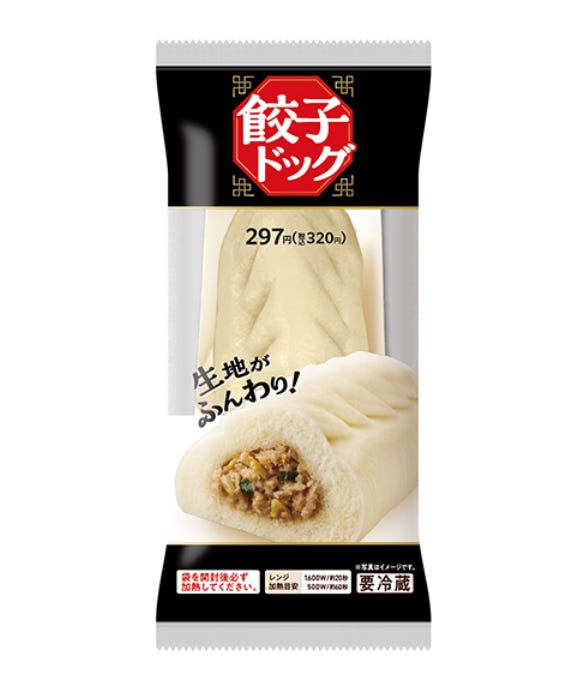
FamilyMart is unnecessarily innovating with this gyoza “sandwich”. This exists in far better form: the nikuman!
Why would any sane person trade a nikuman from the hot box for a room-temperature one in a plastic bag.
Then again, the nikuman disappears in summer months. It’s too darn hot! Conbini punters won’t seem them again until October.
Maybe this is a genius move after all. This could be a way for FamilyMart to serve a nikuman-esque product during summer time.
We’ll need to see how this plays out.
Conbini Haiku
As good as Japan?
Taiwanese convenience store
It is possible
From the Archive
Conbini of the Future

7-11 is showing off its Conbini of the Future at the Osaka Expo. Customers can look forward to hydrogen-powered smoothie machines, remotely operated robots called Newme to answer questions, and digital price tags. Oh, and they’re going to move the coffee machines away from the counter to reduce traffic at checkout.
Get More Hot Conbini Action
That wraps up this week’s newsletter. Keep in touch with all your conbini needs through Twitter.

I find the lack of onigiri comparison disturbing. This is one of the most fascinating points of divergence and unique local flavors in Japanese versus Taiwanese conbinis! Mentaiko chicken versus Hainan chicken... spicy tuna versus Argentine red shrimp... salmon versus basil-flavor fake pork! The texture and consistency of the rice is also different in the two countries.
Loved the humor in this piece. Now you’ve got me wanting to visit my local FamilyMart 😂